
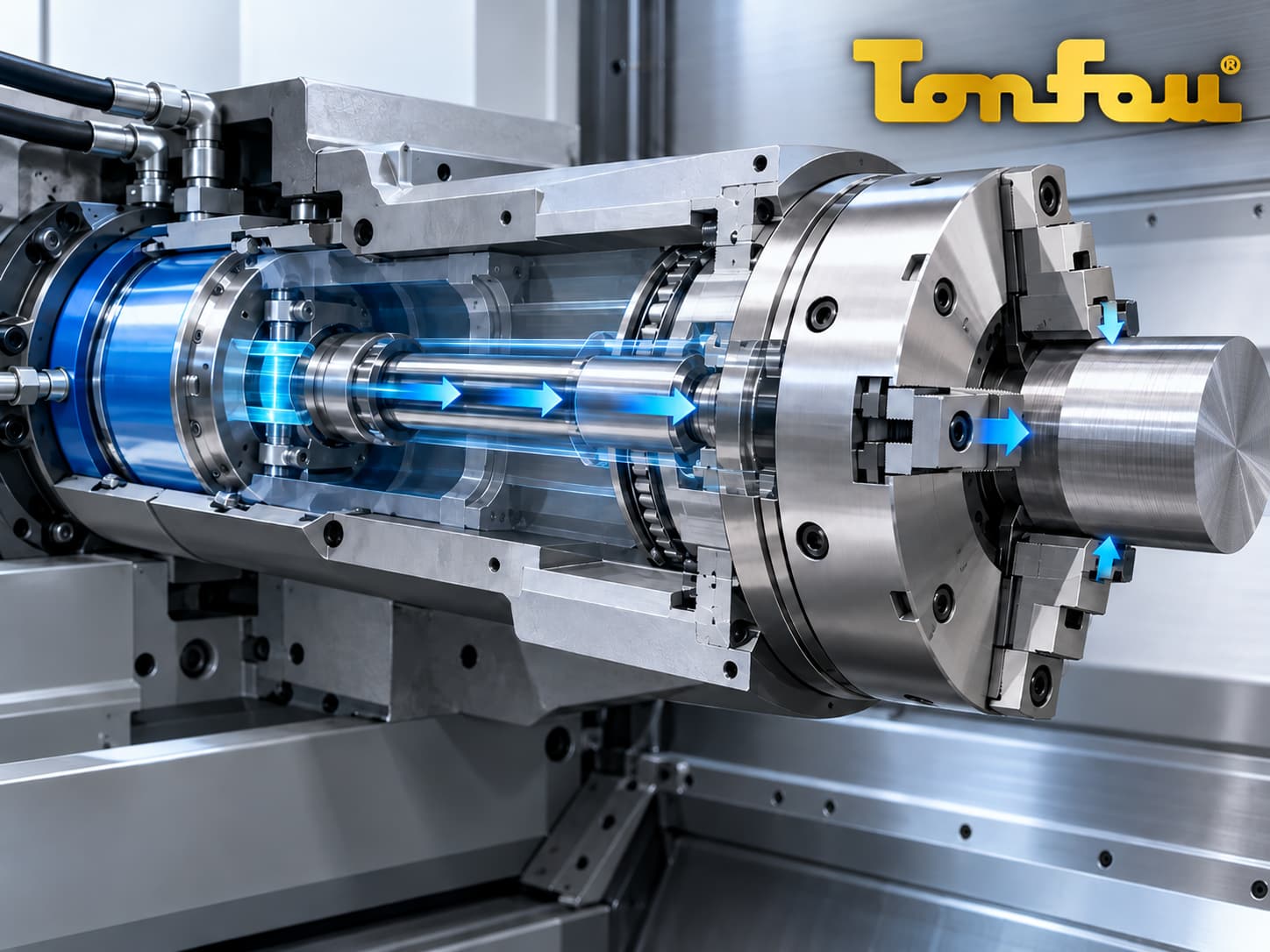
Choosing a non through-hole hydraulic cylinder for a CNC lathe involves more than matching the cylinder size to the machine. Differences in spindle load, draw bar pull force, piston stroke, pressure-retention features, and detection requirements can affect the suitability of a rotary hydraulic cylinder for a particular application.
For manufacturers replacing an existing cylinder, upgrading a CNC lathe, or selecting components for a new machine, understanding these differences can help prevent installation problems, unnecessary specification changes, and production interruptions.
TON FOU offers three non through-hole rotary hydraulic cylinder series: MH, MS, and MS-C. Each has a different design focus, from lightweight construction to built-in pressure-retention and detection features.
This guide compares their characteristics, specifications, and selection considerations to help CNC lathe manufacturers and purchasing teams identify a suitable hydraulic cylinder for their workholding systems.
1. When Should You Review Your Hydraulic Cylinder Selection?
A non through-hole hydraulic cylinder is typically considered for CNC lathe workholding configurations that do not require material to pass through the cylinder.
However, knowing that a machine needs a non through-hole cylinder does not automatically determine which model is suitable. Manufacturers may need to review their cylinder selection under several conditions.
| Production Situation | Selection Concern | What to Review |
|---|---|---|
| Replacing an existing hydraulic cylinder | New cylinder may not match the original installation | Mounting dimensions, connection, piston stroke |
| Upgrading spindle speed | Existing cylinder speed rating may be insufficient | Maximum RPM, rotating mass, inertia |
| Changing to a different power chuck | Pull force or stroke requirements may differ | Chuck compatibility, draw bar connection |
| Increasing automation requirements | Cylinder position feedback may be required | Detection structure and control-system integration |
| Reviewing pressure-loss risks | Additional pressure-retention features may be needed | Built-in check valve and machine safety design |
| Designing a new CNC lathe | Multiple cylinder options are available | System dimensions, weight, performance, functionality |
Key Takeaway: The important question is not simply whether the machine needs a non through-hole hydraulic cylinder. It is whether the selected cylinder provides the right performance and functions for the CNC lathe's operating conditions.
For a broader explanation of the relationship between the chuck, draw tube, and cylinder, see How to Check Whether Your Hydraulic Chuck, Draw Tube, and Rotary Cylinder Are Properly Matched .
2. MH vs. MS vs. MS-C: What Are the Key Differences?
TON FOU's MH, MS, and MS-C Series are all non through-hole rotary hydraulic cylinders, but their design priorities differ.
Quick Comparison: TON FOU Hydraulic Cylinder Series
| Comparison | MH Series | MS Series | MS-C Series |
|---|---|---|---|
| Product type | Non through-hole rotary hydraulic cylinder | Non through-hole rotary hydraulic cylinder | Non through-hole rotary hydraulic cylinder |
| Main design focus | Compact, lightweight construction | Built-in check valve | Built-in check valve and detection structure |
| Lightweight aluminum alloy design | Yes | Not specified | Not specified |
| Built-in check valve | Not specified | Yes | Yes |
| Detection structure | Not specified | Not specified | Yes |
| Available models | MH-75 to MH-200 | MS-105 to MS-200 | MS-105C to MS-200C |
| Maximum operating pressure | 4.0 MPa | 4.0 MPa | 4.0 MPa |
| Maximum rated speed across models | Up to 6,000 RPM | Up to 6,000 RPM | Up to 6,000 RPM |
| Primary selection consideration | Spindle load and compact installation | Pressure retention | Pressure retention and position detection |
Note: Maximum speed and pressure values are published ratings. Actual suitability must be checked against the selected model and complete machine configuration. "Not specified" means the feature is not stated on the referenced product page.
Quick Selection Guide
- Choose MH when lightweight construction, compact dimensions, and spindle load are major considerations.
- Consider MS when a built-in check valve is required for pressure-retention functionality.
- Consider MS-C when the application requires both a built-in check valve and a detection structure.
These distinctions provide an initial selection direction. Final cylinder selection still depends on the required pull force, stroke, rotation speed, and mounting compatibility.
3. When Should You Choose the MH Series?
Lightweight Construction for CNC Lathe Applications
The TON FOU MH Series is manufactured from high-grade aluminum alloy. Its compact and lightweight design is intended to reduce the load on the machine spindle.
This makes MH worth considering for machine builders who must evaluate rotating component weight, available installation space, and operating speed.
What Buyers Should Evaluate
| Selection Factor | Why It Matters |
|---|---|
| Cylinder weight | Affects the rotating load supported by the spindle |
| Compact dimensions | Important when installation space is limited |
| Maximum RPM | Must support the intended machine operating speed |
| Draw bar pull force | Must match the power chuck's actuation requirements |
| Piston stroke | Must provide the movement required by the chuck |
MH Series Specification Highlights
| Model | Piston Stroke | Max. Draw Bar Pull Force | Max. Speed | Weight |
|---|---|---|---|---|
| MH-75 | 15 mm | 15.5 kN | 6,000 RPM | 3.6 kg |
| MH-105 | 20 mm | 32 kN | 6,000 RPM | 6.3 kg |
| MH-125 | 25 mm | 46 kN | 6,000 RPM | 9 kg |
| MH-150 | 30 mm | 63 kN | 5,500 RPM | 12.5 kg |
| MH-200 | 35 mm | 113 kN | 5,500 RPM | 21 kg |
Maximum draw bar pull force values are specified at the manufacturer's rated maximum operating pressure of 4.0 MPa.
When MH May Be Suitable
Consider the MH Series when:
- The CNC lathe design places importance on cylinder weight.
- The spindle assembly has limited installation space.
- The operating speed falls within the selected cylinder's rating.
- The cylinder's pull force and piston stroke match the chosen power chuck.
- Additional pressure-retention or detection features are not part of the specified cylinder requirements.
Key Takeaway: MH is a suitable starting point when the main concern is a compact, lightweight rotary hydraulic cylinder that meets the required mechanical performance.
4. When Is the MS Series a Better Option?
Built-In Check Valve for Pressure Retention
The TON FOU MS Series includes a built-in check valve.
According to TON FOU's product information, this feature is designed to maintain pressure when abnormal conditions occur, such as hydraulic pressure source failure, damaged hydraulic piping, power interruption, or unexpected pressure reduction.
For manufacturers evaluating machine operating risks, the check valve is an important distinction between the MS and MH Series.
Why Does a Built-In Check Valve Matter?
A CNC lathe power chuck depends on hydraulic actuation to maintain the intended clamping condition.
When the hydraulic pressure supply is interrupted, the system must be evaluated for the risk of reduced workpiece holding force.
A built-in check valve provides pressure-retention functionality intended to reduce this risk.
However, a check valve should not be treated as a guarantee against workpiece release. Overall safety depends on the entire hydraulic circuit, chuck condition, leakage characteristics, machine controls, and verified safety measures.
| Operating Concern | MS Series Design Consideration |
|---|