
In CNC turning, machining accuracy depends not only on the machine tool, cutting tool, and program. The workholding system also plays a critical role. A power chuck that does not match the workpiece or machining conditions can lead to vibration, runout, poor surface finish, dimensional errors, and unstable production quality.
For manufacturers producing shafts, flanges, bushings, hydraulic parts, connectors, gear blanks, tubes, or precision metal components, choosing the right power chuck is a production decision—not just a tooling purchase. Even a high-performance CNC lathe may fail to deliver stable results if the chuck, hydraulic cylinder, and jaws are not properly selected.
This article explains common power chuck selection mistakes that affect CNC lathe accuracy and how manufacturers can avoid them by evaluating the complete workholding setup.
Quick Takeaway
A power chuck selection mistake can directly affect CNC lathe accuracy, especially when the chuck does not match the workpiece shape, clamping force, hydraulic cylinder, jaws, or automation requirements.
- Do not choose a power chuck only by size. Workpiece shape, material, weight, and machining load must also be considered.
- Through hole power chucks are suitable for bar feeding, long shafts, tubes, and continuous CNC turning production.
- Non through hole power chucks are often better for short, heavy, flange-type, or high-rigidity workpieces.
- Hydraulic cylinder compatibility affects chuck actuation, clamping stability, and repeatability.
- Jaw selection matters. Hard jaws support strong gripping, while soft jaws help protect finished surfaces and reduce deformation.
Why Power Chuck Selection Affects CNC Lathe Accuracy
A power chuck holds the workpiece during turning, drilling, boring, threading, grooving, and other CNC lathe operations. During machining, the workpiece must remain stable while facing cutting force, spindle rotation, coolant, chips, and repeated loading cycles.
When the chuck is not suitable for the application, machining problems may appear gradually. At first, manufacturers may notice unstable dimensions or poor surface finish. Later, the issue may become more serious, causing rework, tool wear, scrap parts, or machine downtime.
| Accuracy Problem | Possible Workholding Cause | Production Impact |
|---|---|---|
| Runout | Poor clamping accuracy or unsuitable chuck type | Dimensional deviation and assembly issues |
| Vibration | Insufficient chuck rigidity or weak jaw contact | Poor surface finish and shorter tool life |
| Workpiece movement | Clamping force is too low for cutting load | Scrap parts and potential safety risk |
| Part deformation | Clamping force is too high or jaw contact is too small | Out-of-tolerance components |
| Inconsistent results | Chuck, jaws, and hydraulic cylinder are not matched properly | Unstable batch production quality |
To avoid these issues, manufacturers should not choose a power chuck based only on chuck size or price. The selection should be based on workpiece type, machining load, clamping method, production volume, and machine configuration.
Mistake 1: Choosing a Chuck Only by Size
One of the most common mistakes is selecting a power chuck only by its diameter. While chuck size is important, it does not fully determine whether the chuck is suitable for the application.
A chuck may fit the machine spindle but still be unsuitable for the workpiece. For example, a short and heavy flange requires different support compared with a long shaft. A thin-wall tube requires controlled clamping force, while a rough casting may require stronger gripping and better jaw contact.
| Workpiece Condition | What to Consider |
|---|---|
| Long shaft or bar material | Through-hole capacity and bar feeder compatibility |
| Short workpiece | Chuck rigidity and jaw contact area |
| Thin-wall tube | Clamping force control and soft jaw design |
| Heavy part | Chuck strength and secure gripping |
| Finished surface | Surface protection and suitable jaw material |
A suitable chuck should match the actual machining condition, not only the spindle size. Before selecting a chuck, manufacturers should review the workpiece diameter, length, weight, material, wall thickness, and required tolerance.
Mistake 2: Ignoring Workpiece Shape
Different workpiece shapes require different clamping strategies. A round bar may be easy to clamp with a standard 3-jaw chuck, but irregular or special-shaped parts may require different jaw design or a different chuck configuration.
If the chuck does not match the workpiece shape, the clamping contact may be unstable. This can cause eccentricity, vibration, surface marks, or repeated positioning errors.
| Workpiece Type | Possible Selection Risk | Recommended Direction |
|---|---|---|
| Round bar | Usually easier to center, but bar passage may be needed | Consider a through hole power chuck |
| Flange-type part | Short gripping length may reduce stability | Consider a non through hole power chuck |
| Gear blank | Heavy cutting may require stronger rigidity | Select a rigid chuck and suitable hard jaws |
| Thin-wall component | Easy to deform under excessive pressure | Use proper clamping force and soft jaws |
| Irregular part | Standard jaws may not provide enough contact | Consider custom-machined jaws |
For precision CNC turning, workpiece shape should be one of the first selection factors. This helps ensure the chuck can provide stable support throughout the machining process.
Mistake 3: Using the Wrong Chuck Type for Bar Feeding
For manufacturers using long bar stock, through-spindle feeding is often important. If the chuck is not designed for bar feeding, the production process may become slower and less efficient.
A through hole power chuck is designed with an open center, allowing bar stock or tube material to pass through the spindle. This is suitable for continuous CNC turning production, especially when used with a bar feeder.
A non through hole chuck, on the other hand, does not allow material to pass through the chuck center. It is more suitable for short workpieces, flange-type parts, gear components, and applications where higher rigidity or chip protection is needed.
| Chuck Type | Suitable Application | Key Benefit |
|---|---|---|
| Through hole power chuck | Long bars, tubes, shafts, automated feeding | Supports continuous production |
| Non through hole power chuck | Short parts, flanges, gear blanks, heavier workpieces | Supports rigid clamping for non-bar-feeding applications |
Choosing the wrong chuck type may not only affect accuracy but also reduce production efficiency. Manufacturers should confirm whether the process requires bar feeding before selecting a power chuck.
Mistake 4: Overlooking Hydraulic Cylinder Compatibility
A power chuck does not work alone. It must be driven by a suitable hydraulic cylinder. If the chuck and cylinder are not properly matched, the clamping system may not operate smoothly or may fail to provide consistent clamping performance.
For CNC lathe applications, the hydraulic cylinder should match the chuck type, drawtube, spindle structure, stroke requirement, and machine speed. When the cylinder is not suitable, the chuck may open or close inconsistently, affecting repeatability and machining accuracy.
| Selection Point | Why It Matters |
|---|---|
| Cylinder stroke | Affects chuck opening and closing movement |
| Pull force | Influences clamping force and holding stability |
| Maximum speed | Must match spindle speed requirements |
| Through-hole design | Needed for bar feeding applications |
| Mounting compatibility | Reduces installation problems |
For bar feeding applications, manufacturers can consider a through hole hydraulic cylinder. For applications without bar feeding, a non through-hole hydraulic cylinder may be more suitable.
The chuck and hydraulic cylinder should be selected as a complete workholding system rather than two separate components.
Mistake 5: Applying Too Much or Too Little Clamping Force
Clamping force is critical in CNC turning, but stronger clamping is not always better. The correct clamping force depends on the workpiece material, shape, wall thickness, cutting load, spindle speed, and jaw contact area.
If clamping force is too low, the workpiece may slip, vibrate, or move during machining. If clamping force is too high, thin-wall parts or precision components may deform.
| Clamping Issue | Possible Result | How to Avoid It |
|---|---|---|
| Too little clamping force | Workpiece movement, runout, vibration | Increase gripping stability or improve jaw contact |
| Too much clamping force | Part deformation or surface damage | Adjust pressure and use suitable soft jaws |
| Uneven clamping | Eccentricity or unstable repeatability | Check jaw condition and contact area |
| Small contact area | Local pressure marks | Use jaws that match the workpiece profile |
The best clamping solution should provide enough holding force while protecting the workpiece from deformation. This is especially important for thin-wall tubes, precision sleeves, and finished components.
Mistake 6: Choosing the Wrong Jaws
Many machining accuracy problems are not caused by the chuck body itself, but by unsuitable jaws. Jaws are the parts that directly contact the workpiece, so they strongly affect gripping stability, surface protection, and repeatability.
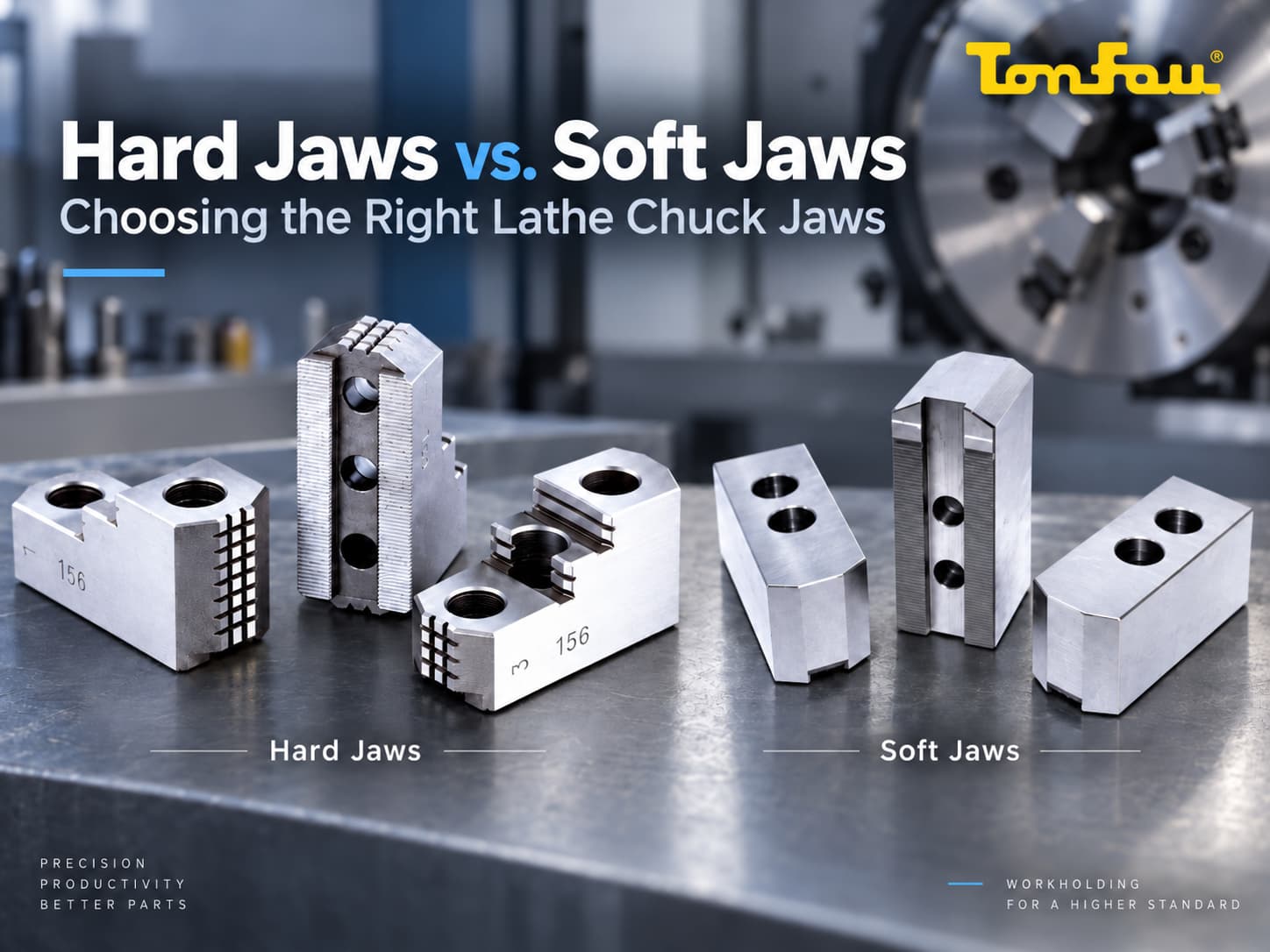
Hard jaws and soft jaws serve different purposes. Hard jaws are generally used for stronger gripping and rough machining, while soft jaws can be machined to match the workpiece shape more closely.
| Jaw Type | Suitable Use | Main Advantage |
|---|---|---|
| Hard jaws | Raw material, rough machining, heavy-duty clamping | Strong and durable gripping |
| Soft jaws | Finished surfaces, precision parts, irregular profiles | Better contact and reduced surface damage |
| Custom-machined soft jaws | Thin-wall or special-shaped workpieces | Improved support and lower deformation risk |
Using hard jaws on a finished surface may cause marks. Using unsuitable soft jaws for heavy cutting may reduce gripping stability. For this reason, jaw selection should be part of the power chuck selection process.
Mistake 7: Ignoring Runout and Repeatability Requirements
Some manufacturers focus mainly on whether the chuck can hold the workpiece, but precision machining requires more than basic clamping. Runout and repeatability are important for parts that must meet tight dimensional tolerances.
Runout can affect roundness, concentricity, surface finish, and assembly accuracy. Poor repeatability can cause variation between parts in mass production.
| Requirement | Why It Matters |
|---|---|
| Low runout | Helps maintain concentricity and dimensional accuracy |
| High repeatability | Supports stable batch production |
| Stable jaw positioning | Reduces variation between loading cycles |
| Proper maintenance | Prevents accuracy loss caused by wear or chips |
For precision parts, manufacturers should evaluate chuck accuracy, jaw condition, machine setup, and hydraulic actuation together. A stable clamping system helps maintain consistent results over long production runs.
Mistake 8: Not Considering Automation Needs
As more CNC lathe production lines use bar feeders, robotic loading, and automatic part handling, chuck selection must also consider automation compatibility.
A chuck used in automated production must open and close reliably, clamp consistently, and support repeated loading cycles. If the chuck cannot maintain stable performance, automation may increase production problems instead of solving them.
| Automation Condition | Workholding Requirement |
|---|---|
| Bar feeder production | Through hole chuck and through hole hydraulic cylinder |
| Robotic loading | Consistent chuck opening and closing movement |
| High-volume production | Stable repeatability and durable components |
| Frequent changeover | Efficient jaw setup and easy adjustment |
| Long machining cycles | Reliable clamping and reduced maintenance risk |
For automated CNC turning, manufacturers should select a workholding system that supports both speed and reliability.
Mistake 9: Using a Power Chuck When a Collet Chuck May Be Better
Power chucks are versatile, but they are not always the best choice for every application. For smaller parts, consistent bar diameters, or high-repeatability machining, a collet chuck may be a better option.
Collet chucks can provide stable gripping around the workpiece and are often used in applications where repeatability, concentricity, and efficient changeover are important.
| Workholding Option | Suitable Application |
|---|---|
| Power chuck | General CNC turning, larger workpieces, flexible clamping |
| Through hole power chuck | Bar feeding and continuous production |
| Non through hole power chuck | Short, heavy, or high-rigidity workpieces |
| Collet chuck | Small parts, consistent bar stock, high-repeatability machining |
Manufacturers should compare the workpiece size, material, tolerance, and production method before deciding between a power chuck and a collet chuck.
Mistake 10: Treating the Chuck as a Standalone Component
A power chuck is only one part of the complete workholding system. CNC lathe accuracy depends on the interaction between the chuck, hydraulic cylinder, jaws, drawtube, spindle, coolant condition, chip management, and maintenance routine.
If one component is unsuitable, the entire clamping system may be affected.
| System Component | Role in CNC Lathe Accuracy |
|---|---|
| Power chuck | Holds and centers the workpiece |
| Hydraulic cylinder | Provides clamping actuation |
| Jaws | Contact and support the workpiece |
| Drawtube | Transfers force between cylinder and chuck |
| Coolant and chip management | Helps maintain clean and stable operation |
| Maintenance | Prevents wear-related accuracy loss |
For applications with heavy coolant usage or chip accumulation, a coolant collector can also be considered as part of the machining setup.
How to Avoid Power Chuck Selection Mistakes
Before selecting a power chuck, manufacturers should review the full production condition. The following checklist can help reduce selection risks.
| Checklist Question | Why It Matters |
|---|---|
| What is the workpiece shape and size? | Determines chuck type and jaw design |
| Is the material bar stock, tube, casting, or pre-cut blank? | Determines whether through-hole design is needed |
| What tolerance must the part meet? | Determines accuracy and repeatability requirements |
| Is the part thin-wall or easy to deform? | Determines clamping force and soft jaw needs |
| Is the process rough machining or finishing? | Determines jaw type and gripping strategy |
| Will the machine use a bar feeder or robot? | Determines automation compatibility |
| What hydraulic cylinder is required? | Ensures stable chuck actuation |
| How often will the chuck be used? | Determines durability and maintenance needs |
A good selection process should start from the workpiece and production goal, then move to chuck type, hydraulic cylinder, jaws, and accessories.
TON FOU Workholding Solutions for CNC Lathe Applications
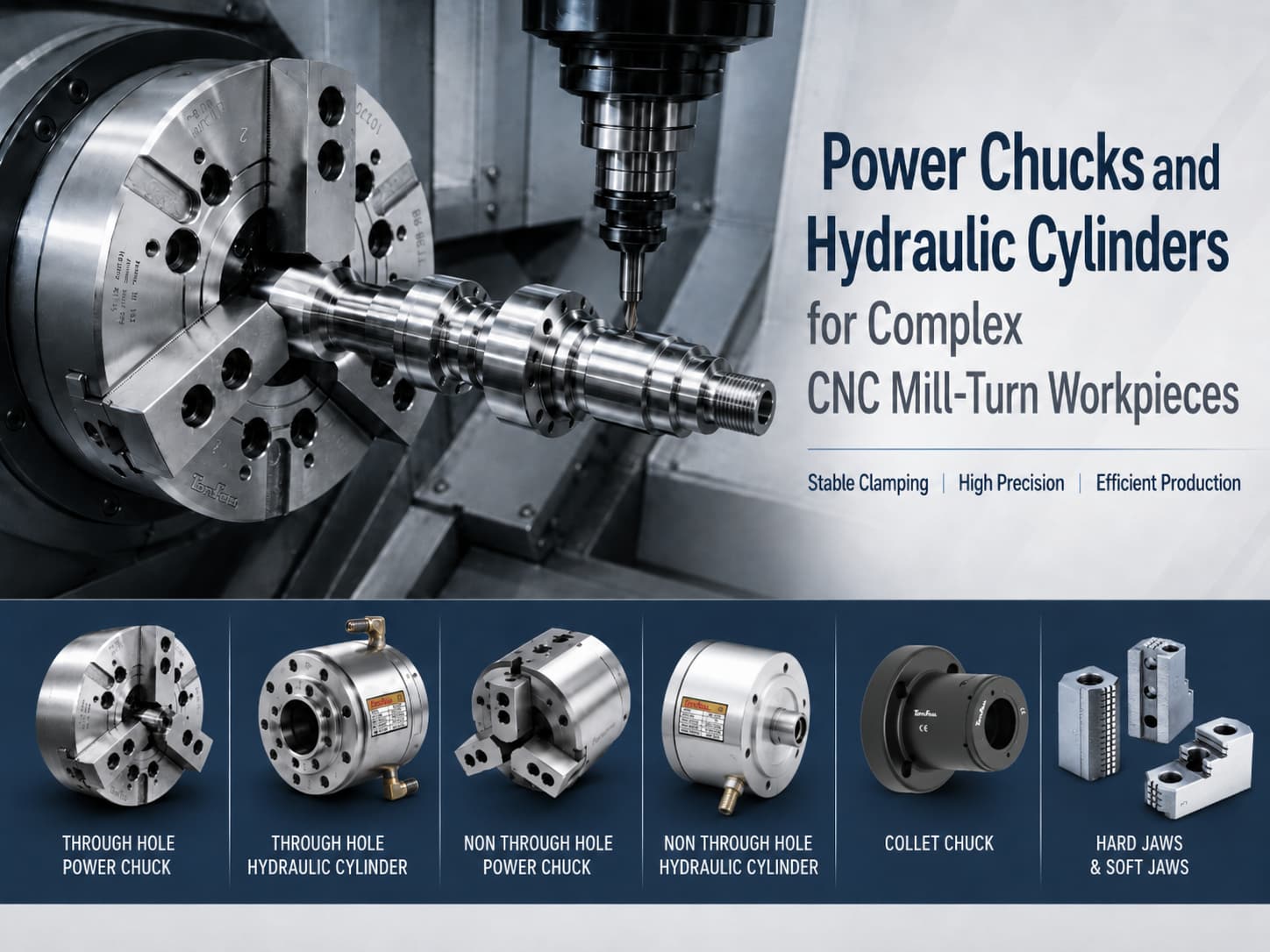
TON FOU provides a range of workholding products for CNC turning applications, including power chucks, hydraulic cylinders, collet chucks, jaws, and related components. These products help manufacturers build stable clamping systems for different workpiece types and production requirements.
| TON FOU Product | Suitable Application |
|---|---|
| Through Hole Power Chuck | Bar feeding, shaft machining, tube machining, continuous CNC turning |
| Non Through Hole Power Chuck | Short workpieces, flanges, gear blanks, high-rigidity clamping |
| Through Hole Hydraulic Cylinder | Through-spindle feeding and automated bar production |
| Non Through-Hole Hydraulic Cylinder | Compact setups and applications without bar feeding |
| Collet Chuck | Small parts, bar stock, high-repeatability machining |
| Hard Jaws & Soft Jaws | Rough machining, precision clamping, custom gripping needs |
| Coolant Collector | Cutting fluid collection and machining environment management |
By evaluating the full clamping system, manufacturers can reduce accuracy problems and improve CNC lathe productivity.
Conclusion
Power chuck selection has a direct impact on CNC lathe accuracy. Mistakes such as choosing only by chuck size, ignoring workpiece shape, using the wrong chuck type for bar feeding, overlooking hydraulic cylinder compatibility, or selecting unsuitable jaws can lead to runout, vibration, deformation, poor surface finish, and unstable production quality.
The right workholding solution should be selected based on the workpiece, machining load, accuracy requirement, automation level, and long-term production needs. A suitable combination of power chuck, hydraulic cylinder, jaws, and accessories helps manufacturers improve machining stability, reduce errors, and maintain consistent part quality.
For manufacturers looking to improve CNC turning performance, TON FOU offers power chucks, hydraulic cylinders, collet chucks, jaws, and related workholding components designed to support reliable and efficient CNC lathe applications.
Looking for a Reliable Power Chuck Solution?
If your CNC lathe production is facing runout, vibration, unstable dimensions, workpiece deformation, or clamping problems, the power chuck may be one of the key factors to review. TON FOU can help manufacturers evaluate suitable power chucks, hydraulic cylinders, jaws, and related workholding components based on workpiece type, machine configuration, and production requirements.
Contact TON FOU