
Overcoming Centrifugal Force: Why Your Choice of Collet Chuck Matters for High-Speed Machining
As CNC spindle speeds continue to rise in pursuit of higher productivity and finer surface finishes, manufacturers face an increasingly important challenge: centrifugal force.
At high RPM, even a small reduction in effective clamping force can lead to part slippage, vibration, poor surface finish, or catastrophic machining failure. While many machinists understand that collet chucks are generally better suited for high-speed turning, fewer realize that not all collet chucks perform equally under centrifugal load.
In this article, we’ll explain why collet chuck selection matters—and what manufacturers should consider when choosing a collet chuck for high-speed machining applications.
Why Centrifugal Force Becomes a Problem in High-Speed Machining
As spindle speed increases, centrifugal force acts outward on all rotating components—including the chuck itself and the workpiece.
Because centrifugal force increases exponentially with rotational speed:
- Clamping components expand outward
- Effective gripping force decreases
- System imbalance becomes more pronounced
- Runout and vibration increase
Even with a collet chuck, poor design or incorrect sizing can reduce performance dramatically under these conditions.
Why Collet Chucks Are Better Suited for High-Speed Machining
Compared to traditional jaw chucks, collet chucks offer several structural advantages for high-RPM applications:
360° Uniform Clamping
Collets grip the entire circumference of the workpiece rather than a few contact points, distributing force more evenly.
Lower Rotating Mass
Most collet systems are lighter than power chucks, reducing inertia and dynamic imbalance.
Superior Concentricity
Uniform radial clamping improves runout performance and helps maintain stable cutting conditions.
Better Surface Finish
Reduced vibration and more consistent clamping improve part quality.
What Is a Collet Chuck?
A collet chuck is a high-precision clamping tool commonly used in sliding headstock lathes, also known as Swiss-type lathes. It is ideal for bar stock machining and is often paired with a bar feeder for continuous processing.
A collet chuck can also serve as a replacement for a standard power chuck and can accommodate steel collets in various shapes and sizes, depending on the customer's specific application requirements.
At TON FOU, our collet chuck systems are engineered to deliver exceptional:
- Rigidity
- Repeatability
- Durability
These advantages help reduce workpiece changeover time and significantly improve overall machining efficiency.
Key Factors That Determine Collet Chuck Performance at High RPM
1. Collet Chuck Balance Quality
Poorly balanced collet chucks generate vibration at high speed—even if the spindle itself is perfectly balanced.
Look for:
- Precision-balanced chuck body
- Symmetrical collet seat design
- High-speed rated balancing specifications
2. Clamping Force Retention Under RPM
Not all collet systems maintain clamping force equally as speed increases.
Critical design considerations include:
- Anti-expansion chuck geometry
- Optimized taper angles
- High-rigidity chuck body materials
3. Collet Size Matching
Using oversized or undersized collets reduces grip quality and increases runout.
Best practice:
- Match collet size closely to workpiece diameter
- Avoid over-compressing beyond recommended range
- Use dedicated collets for critical tolerance applications
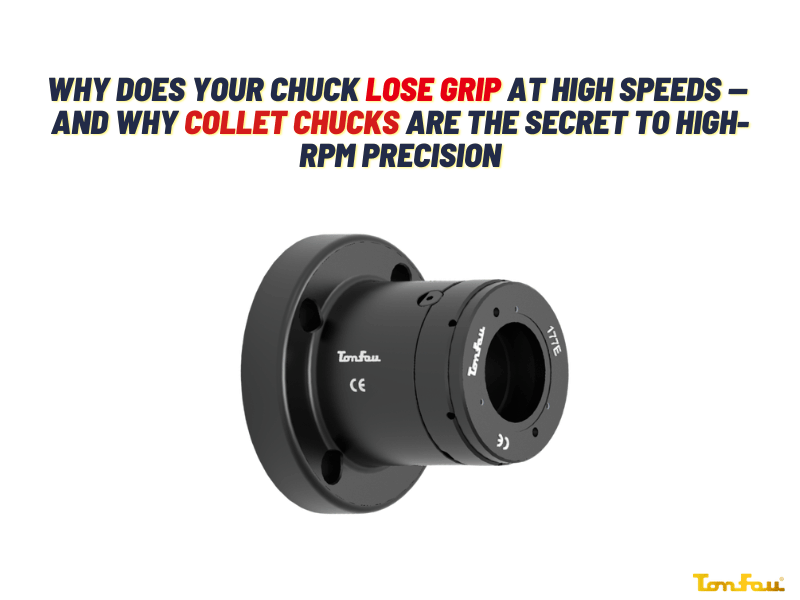
Featured Solution: TON FOU CL52-A6D Collet Chuck
For manufacturers seeking a high-performance collet chuck optimized for CNC turning applications, the TON FOU CL52-A6D Collet Chuck is an excellent solution.
Designed for precision bar stock machining and high-speed spindle environments, the CL52-A6D offers:
- High-precision concentric clamping for demanding tolerance control
- Stable gripping performance under high RPM operation
- Compatibility with automated bar feeder systems
- Fast workpiece changeover for improved production efficiency
- Robust construction for long-term durability in continuous production
Its design makes it especially suitable for:
- Swiss-type lathes
- CNC turning centers
- High-speed bar stock machining
- Precision shaft and pin production
By combining excellent rigidity with superior repeatability, the CL52-A6D helps manufacturers maintain machining stability even in challenging high-speed applications.
View Product: TON FOU CL52-A6D Collet Chuck
Why Collet Chuck Selection Directly Impacts Productivity
Choosing the right collet chuck improves more than just holding power—it affects your entire machining process:
| Benefit | Impact |
|---|---|
| Higher RPM Stability | Faster cycle times |
| Lower Runout | Better dimensional accuracy |
| Reduced Vibration | Improved tool life |
| Better Grip Retention | Fewer part slippage incidents |
| Improved Balance | Better spindle longevity |
In high-volume production environments, these gains compound quickly into measurable ROI.
Final Thoughts
High-speed machining pushes every part of your spindle system to its limits—and centrifugal force is one of the most overlooked factors in chuck selection.
While collet chucks are often the best solution for high-RPM applications, the specific design and quality of the collet chuck determine whether it truly performs under speed.
Choosing a precision-engineered solution like TON FOU’s collet chuck systems can help manufacturers overcome centrifugal-force-related clamping challenges while improving machining consistency, efficiency, and long-term reliability.
Ready to Improve Your High-Speed Machining Performance?
TON FOU offers precision-engineered collet chuck solutions for manufacturers seeking stable, reliable clamping in demanding CNC turning applications.
Contact us today to discuss your machining requirements and discover the right chucking solution for your spindle speed, workpiece size, and production goals.
???? Visit: https://www.tonfou.com
???? Contact Us: https://www.tonfou.com/en-US/contact