

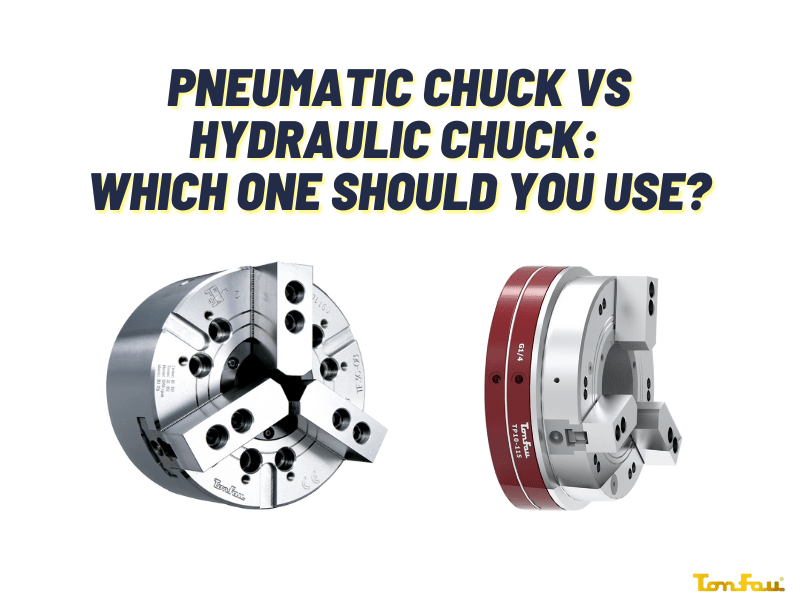
What Is a Pneumatic Chuck? A Complete Guide with Real-World Application
In the world of CNC machining and automated turning operations, clamping performance directly impacts precision, efficiency, and safety. One solution gaining increasing attention in high-speed, automated environments is the pneumatic chuck. But what exactly is it, how does it work, and where is it best used?
Let’s break it down—and see how models like the TP10-115A8 through-hole power chuck from TON FOU can be applied in practical pneumatic systems.
What Is a Pneumatic Chuck?
A pneumatic chuck is a type of power chuck that uses compressed air as its actuation source to clamp and release workpieces. Unlike manual chucks, which require operator intervention, pneumatic chucks enable automatic, consistent clamping through air pressure—making them ideal for automated production lines and high-volume machining.
Key Features:
- Air-actuated clamping using solenoid valves or air regulators
- Fast clamping/unclamping cycles for increased throughput
- Consistent clamping force without human error
- Often used in CNC lathes, rotary indexers, or robotic systems
How Pneumatic Chucks Work
Pneumatic chucks function by sending compressed air into a piston chamber inside the chuck body. The resulting movement either pushes or pulls a wedge mechanism that moves the chuck jaws inward or outward. Once air pressure is applied, the jaws securely grip the workpiece with uniform force. When air is released or reversed, the jaws retract, allowing for fast part changeover.
In many cases, pneumatic chucks are integrated with sensors for clamp confirmation, supporting Industry 4.0 needs like traceability and automation feedback.
Pneumatic vs. Hydraulic Chuck: What's the Difference?
| Feature | Pneumatic Chuck | Hydraulic Chuck |
|---|---|---|
| Actuation Source | Compressed air | Hydraulic fluid (oil) |
| Response Speed | Very fast | High force, slower actuation |
| Maintenance | Easier, cleaner | Requires oil management |
| Max Clamping Force | Moderate | Higher |
| Ideal Applications | High-speed, light-to-mid duty | Heavy-duty, high-force operations |
Real-World Example: TP10-115A8 Power Chuck from TON FOU
One excellent example of a chuck suitable for pneumatic integration is the TP10-115A8 from TON FOU. While categorized as a high-speed hollow hydraulic chuck, its structural design—with a 115 mm through-hole and wedge-type actuation—makes it well-suited for pneumatic adaptation as well.
Key Specifications:
- Through-hole diameter: 115 mm
- Max RPM: 2800
- Jaw stroke: 8.3 mm (diameter)
- Max draw pull: 45 kN
- Compatible with A8 spindle nose
Where Pneumatic Chucks Are Commonly Used
- CNC lathes with bar feeders
- Robotic machining and part-handling systems
- Production lines with frequent changeovers
- Clean or dry environments where hydraulics are less ideal
- Turn-mill centers or live tooling setups
Conclusion: Is a Pneumatic Chuck Right for Your Application?
If your goal is faster cycle times, minimal maintenance, and automation readiness, a pneumatic chuck may be the right fit—especially when combined with a robust, high-precision model like the TP10-115A8. By selecting a chuck that offers both structural performance and integration flexibility, you future-proof your CNC operations for speed, consistency, and reliability.
Ready to Upgrade Your Clamping System?
Explore how TON FOU’s high-performance chucks like the TP10-115A8 can be integrated into your pneumatic or automated setup.
Contact us today to discuss your application needs, or browse our full product lineup to find the perfect match for your machine.
Learn More
Pneumatic Chuck vs Hydraulic Chuck: Which One Should You Use?